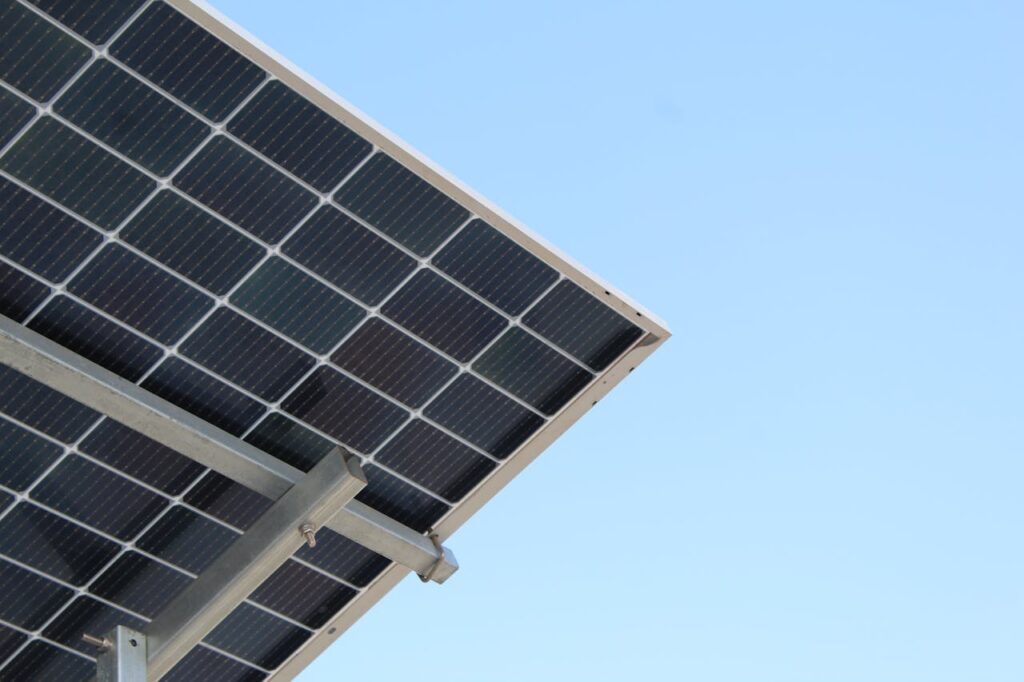

Off-grid solar sounds complicated. Five different components, electrical formulas, battery chemistry, voltage decisions — it’s easy to feel overwhelmed before you buy a single piece of equipment. But the core concept is simple: panels collect sunlight, batteries store it, and an inverter turns it into the electricity your appliances use. Everything else is just sizing each piece correctly so the system works reliably.
This guide walks through the entire process in five clear steps, starting from zero knowledge.
The 5 Components of Every Off-Grid Solar System
Before sizing anything, understand what you’re building. Every off-grid system has the same five parts:
- Solar panels — convert sunlight into DC electricity
- Charge controller — regulates the current flowing from panels to batteries, preventing overcharging
- Battery bank — stores energy for nighttime use and cloudy days
- Inverter — converts DC battery power into AC electricity for household appliances
- Wiring and safety equipment — cables, fuses, breakers, and disconnects
The energy flow is straightforward: sunlight hits the panels, the charge controller feeds that energy into the batteries, and the inverter pulls from the batteries to power your appliances. During the day, panels can simultaneously charge batteries and power loads. At night, everything runs from stored battery energy.
That’s the entire system. Now let’s size each piece.
Step 1 — Calculate Your Daily Energy Consumption
Every solar calculation starts here. For each appliance you want to run, multiply its wattage by the number of hours you use it per day. The result is watt-hours (Wh).
A quick example:
- LED lights (6 bulbs at 10W each): 60W × 5 hours = 300 Wh
- Refrigerator: 150W × 12 hours (compressor duty cycle) = 1,800 Wh
- Laptop: 60W × 4 hours = 240 Wh
- WiFi router: 12W × 24 hours = 288 Wh
- TV: 70W × 3 hours = 210 Wh
- Phone chargers: 20W × 3 hours = 60 Wh
Total: 2,898 Wh = 2.9 kWh per day.
The critical step most people skip is splitting this into daytime and nighttime consumption. Your panels only produce during the day, so everything running at night must come from batteries. A household using 4 kWh during the day and 1 kWh at night needs a very different battery bank than one using 2 kWh during the day and 3 kWh at night — even though both total 5 kWh.
For a deeper dive into this process, see our guide on calculating your home’s daily energy consumption.
Step 2 — Size Your Solar Panels
The panel formula is: panels = ceil((totalKWh ÷ (panelWatt ÷ 1000 × sunHours)) × (1 + lossPercent ÷ 100))
In plain English:
- totalKWh — your total daily consumption from Step 1 (day + night combined, because panels must generate enough to cover both)
- panelWatt — the wattage of each panel (common sizes: 400W, 500W, 600W)
- sunHours — peak sun hours for your location (not daylight hours — this is a critical distinction)
- lossPercent — real-world losses from wiring, heat, dust, and inverter inefficiency (typically 25%)
Example: 5 kWh/day total consumption, 600W panels, 5 peak sun hours, 25% losses.
Panels = ceil((5 ÷ (0.6 × 5)) × 1.25) = ceil((5 ÷ 3) × 1.25) = ceil(2.08) = 3 panels.
Three 600W panels in this scenario. Change any variable — fewer sun hours, higher losses, bigger consumption — and the count goes up.
Step 3 — Size Your Battery Bank
The battery formula is: batteryKWh = (nightKWh × autonomyDays) ÷ (DoD × efficiency)
Each variable matters:
- nightKWh — your nighttime consumption from Step 1
- autonomyDays — how many cloudy days your battery should cover without any solar input (1.5 to 3 days is typical)
- DoD (Depth of Discharge) — how deeply you can drain the battery without damaging it. Lithium batteries allow 80% discharge. Lead-acid only 50%.
- efficiency — not all stored energy is recoverable. Lithium: 95%. Lead-acid: 85%.
Example: 2.5 kWh nighttime consumption, 2 autonomy days, lithium batteries.
Battery = (2.5 × 2) ÷ (0.80 × 0.95) = 5 ÷ 0.76 = 6.58 kWh.
The same scenario with lead-acid: (2.5 × 2) ÷ (0.50 × 0.85) = 5 ÷ 0.425 = 11.76 kWh — nearly double the capacity for the same usable energy. This is why battery chemistry is one of the biggest cost decisions in an off-grid system.
Step 4 — Size Your Inverter
The inverter formula is: inverterKW = ceil(peakLoadWatts × 1.30 ÷ 1000)
The key concept: size for the peak simultaneous load, not the average. List every appliance that could run at the same time and add their wattages.
Example: Refrigerator (150W) + microwave (1,000W) + lights (50W) + laptop (60W) = 1,260W peak.
With 30% safety margin: 1,260 × 1.30 = 1,638W. Rounded up to a 2 kW inverter.
The 30% margin covers motor startup surges. Appliances with compressors — fridges, AC units, pumps — can spike to 3 to 5 times their rated wattage for the first few seconds. Always choose a pure sine wave inverter for off-grid use. Modified sine wave inverters are cheaper but can damage sensitive electronics and make motors run hot.
Step 5 — Size Your Charge Controller
The charge controller formula is: amps = ceil((totalSystemWatt ÷ batteryVoltage) × 1.25)
Example: 1,800W of panels, 24V battery bank.
Amps = ceil((1,800 ÷ 24) × 1.25) = ceil(93.75) = 94A charge controller.
The 25% margin accounts for brief moments when panels can exceed their rated output in cool, clear conditions.
For the controller type: MPPT controllers are the right choice for any system above 400W or where panel voltage doesn’t match battery voltage. PWM controllers are only practical for very small, voltage-matched systems.
How you wire your panels — series vs parallel — also affects what charge controller you need. Series wiring increases voltage, which MPPT controllers handle efficiently. Parallel wiring keeps voltage low but increases current.
Common Beginner Mistakes to Avoid
- Using daylight hours instead of peak sun hours. A location with 12 hours of daylight might only have 4 to 5 peak sun hours. Using 12 will make your system 50% too small.
- Ignoring nighttime consumption in panel sizing. Your panels must generate enough to power daytime loads AND charge batteries for the night. Sizing panels for daytime consumption alone leaves your batteries perpetually undercharged.
- Forgetting system losses. Real-world panels produce 20 to 35% less than their rated wattage due to heat, dust, wiring resistance, and inverter inefficiency.
- Sizing the inverter for average load instead of peak. The inverter must handle the worst-case moment when everything runs at once, not the average draw over a day.
- Choosing lead-acid without understanding depth of discharge. A 200Ah lead-acid battery gives you only 100Ah of usable capacity. The same 200Ah in lithium gives you 160Ah.
- Setting autonomy to 1 day. One cloudy day and your batteries are empty by nightfall. Plan for at least 1.5 to 2 days of backup.
For a deeper look at these pitfalls, see our full article on solar system sizing mistakes.
Let the Calculator Do the Math
Our Solar System Calculator walks through this entire process on one page. Enter your appliances using the preset dropdown or add custom ones, set your location’s peak sun hours, choose your battery type, adjust the loss factor, and pick your autonomy days. The calculator instantly shows your panel count, battery bank (in kWh and Ah), inverter size, and charge controller rating — all using the same formulas explained above.
The difference between a well-sized system and a guess can be thousands of dollars in wasted equipment or a system that fails on the first cloudy day. Start with real numbers and the rest falls into place.