Heat pumps are replacing furnaces and boilers across the world, and for good reason — they deliver 3 to 4 times more heating energy than the electricity they consume. But running one off-grid means sizing your solar system for one of the most demanding appliances in a home. The answer ranges from 3 to 18 panels depending on the type of heat pump, your winter climate, and how many hours per day it runs. Here’s how to get the exact number for your setup.
Why Heat Pumps Are Different from Every Other Appliance
A heat pump doesn’t generate heat — it moves it. This is measured by its Coefficient of Performance (COP). A heat pump with a COP of 3.5 delivers 3,500W of heating for every 1,000W of electricity it consumes. Compare that to a resistive electric heater, which has a COP of 1.0 — it gives you exactly 1,000W of heat for 1,000W of electricity. That efficiency is why heat pumps are taking over, but the electrical draw is still significant.
The type you choose determines everything:
- Mini-split heat pumps: 500–2,000W. The most efficient option for single rooms or small homes. Variable-speed compressors adjust output rather than cycling on and off.
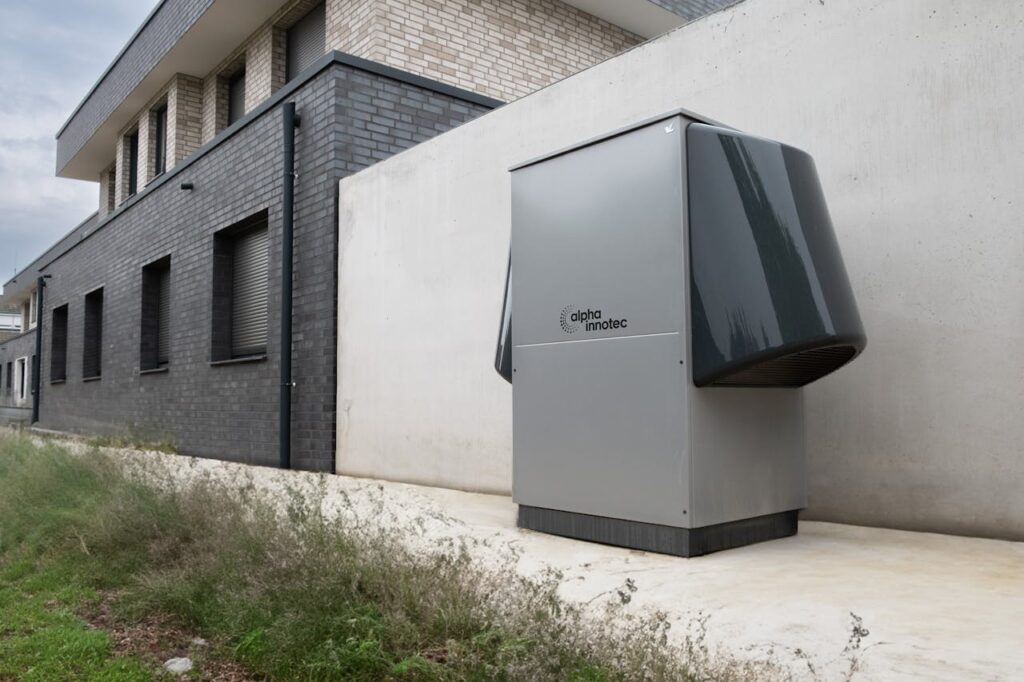
- Air-source heat pumps: 1,000–4,000W. Whole-house heating and cooling in one unit. Most common for residential off-grid systems.
- Ground-source (geothermal) heat pumps: 3,000–6,000W. Highest COP (4.0–5.0) but require expensive ground loops. Rarely practical for off-grid unless the budget allows it.
Understanding Your Heat Pump’s Real Power Draw
The wattage on the nameplate is measured under mild conditions — typically around 7°C. In real winter weather, the story changes dramatically.
As outdoor temperature drops, an air-source heat pump works harder to extract heat from colder air. A unit rated 1,500W at 7°C may draw 2,500W at -5°C as its COP drops from 3.5 to around 2.0. That’s a 50–70% increase in electricity consumption for the same heating output. On top of that, the unit runs defrost cycles every 30 to 90 minutes in cold weather, temporarily reversing operation to melt ice off the outdoor coil, which spikes the draw further.
Then there’s the startup surge. When the compressor kicks in, it draws 2 to 3 times its rated wattage for a few seconds — less severe than an air conditioner compressor but still enough to trip an undersized inverter.
The key rule: always size your solar system for the coldest month’s wattage, not the mild-weather rating. If you size for spring conditions, you’ll run out of power in January. Factor in the additional system losses that cold weather introduces — snow cover on panels, shorter days, and reduced battery performance.
The Panel Math: Three Real Scenarios
Let’s work through three scenarios using 600W panels, a 25% system loss factor, and the same formula our calculator uses.
Scenario A — Mini-Split, Moderate Winter
A 1,200W mini-split running 8 hours per day (6 daytime, 2 at night) with 4.5 peak sun hours (winter average at mid-latitude). Daily consumption: 1,200 × 8 ÷ 1,000 = 9.6 kWh. Each 600W panel produces 0.6 × 4.5 = 2.7 kWh/day. Raw panels: 9.6 ÷ 2.7 = 3.56. With 25% losses: 3.56 × 1.25 = 4.44, rounded up to 5 panels for the heat pump alone.
Scenario B — Air-Source, Cold Climate
A 2,500W air-source unit (cold-weather draw) running 12 hours per day (6 daytime, 6 at night) with only 3.5 peak sun hours (winter, northern latitude). Daily consumption: 2,500 × 12 ÷ 1,000 = 30 kWh. Each panel produces 0.6 × 3.5 = 2.1 kWh/day. Raw panels: 30 ÷ 2.1 = 14.29. With losses: 14.29 × 1.25 = 17.86, rounded up to 18 panels for the heat pump alone. That’s a massive system — see cost-reduction strategies below.
Scenario C — Mini-Split, Daytime Only, Good Sun
The same 1,200W mini-split but running only 6 hours during peak sun (10 AM to 4 PM) with 5.0 peak sun hours. Daily consumption: 1,200 × 6 ÷ 1,000 = 7.2 kWh. Each panel: 0.6 × 5.0 = 3.0 kWh/day. Raw panels: 7.2 ÷ 3.0 = 2.4. With losses: 2.4 × 1.25 = 3.0, rounded up to 3 panels.
The takeaway: heat pump type, run hours, and winter sun hours create enormous variation. The difference between Scenario B and C is 15 panels. This is why plugging in your real numbers matters more than following any rule of thumb.
Battery and Inverter Sizing for a Heat Pump
If you run the heat pump at night, battery sizing becomes the most expensive part of your system.
Take Scenario A: 2 hours of nighttime heating at 1,200W = 2.4 kWh of nighttime consumption. Using the battery formula with 2 autonomy days:
- Lithium (LiFePO4): (2.4 × 2) ÷ (0.80 × 0.95) = 6.3 kWh of battery capacity
- Lead-acid: (2.4 × 2) ÷ (0.50 × 0.85) = 11.3 kWh — nearly double for the same usable energy
There’s a critical cold-weather catch: lithium LiFePO4 batteries cannot charge below 0°C without a heated enclosure or built-in heating element. Lead-acid batteries can charge down to -20°C but with significantly reduced capacity. For off-grid heating systems, battery placement and insulation are just as important as battery size.
For the inverter, the standard 30% safety margin gives: 1,200 × 1.30 ÷ 1,000 = 1.56, rounded up to a 2 kW inverter. With startup surge (2–3x), you need at least a 3 kW surge rating. For Scenario B’s 2,500W air-source unit: 2,500 × 1.30 ÷ 1,000 = 3.25, rounded up to a 4 kW inverter with a 6+ kW surge rating. See our full inverter sizing guide for details.
For any system above 5 kW total, a 48V configuration is strongly recommended to keep cable sizes manageable and reduce current-related losses.
Four Ways to Shrink Your Heat Pump Solar System
Running a heat pump off-grid is expensive, but there are practical ways to reduce the system you need:
1. Choose a high-COP inverter-driven heat pump. Variable-speed compressor models (COP 4.0+) use 20–30% less electricity than fixed-speed models (COP 2.5–3.0) for the same heating output. Same warmth, fewer panels.
2. Heat during peak sun hours and coast at night. Run the heat pump aggressively from 10 AM to 4 PM when panels are producing, raise the interior to 22–24°C, then let insulation hold the temperature overnight. This eliminates or drastically reduces nighttime battery drain — the most expensive part of the system.
3. Insulate before you size. Every dollar spent on insulation saves $3–5 in solar equipment. Seal air leaks, add attic insulation, upgrade windows. Size the building envelope first, then size the solar system. The cheapest kilowatt-hour is the one you never use.
4. Consider a hybrid approach for extreme cold. In climates where temperatures regularly drop below -15°C, a small propane backup heater for the coldest nights can cut your solar system size by 30–40%. The heat pump handles 90% of heating days efficiently, and the backup covers the extremes that would otherwise require a massively oversized solar array.
Size Your Heat Pump Solar System in Minutes
Our Solar System Calculator handles the math for you. Enter your heat pump as a custom appliance using the actual wattage from the nameplate or spec sheet — and use the cold-weather wattage, not the mild-conditions rating.
Set daytime and nighttime hours to match your real heating pattern. Adjust the system losses to 30% for cold climates (snow cover, shorter days, and cold-weather panel derating add up). Set autonomy days to at least 2 for winter use — cold snaps with overcast skies can last 3 to 5 days in northern regions.
The difference between a well-sized and poorly-sized heat pump solar system can be thousands of dollars in equipment — or a house that goes cold on the worst night of the year.