
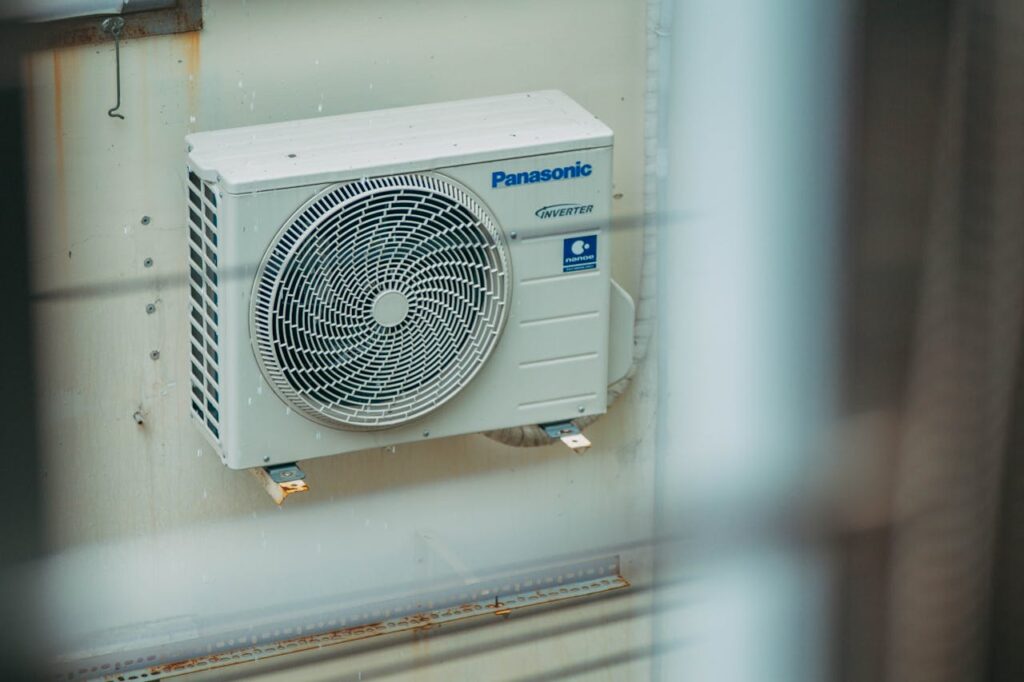
Air conditioning is the appliance that breaks most off-grid solar designs. It draws more power than anything else in a typical home, it runs for hours on end, and its compressor motor creates enormous startup surges that can trip an undersized inverter in seconds.
The short answer is that a standard 1,500W air conditioner needs anywhere from 4 to 10 solar panels — but the real number depends on how many hours you run it, your local sun hours, and whether you need it at night. Here’s how to get the exact count for your situation.
Why Air Conditioning Is the Hardest Appliance for Solar
Look at the numbers and the reason is obvious. A typical 12,000 BTU window unit or mini-split draws around 1,500W while running. That’s more than 12 times the draw of a refrigerator (120W) and 150 times an LED light (10W).
But the wattage alone isn’t the full story. An AC unit runs for long stretches — 6 to 12 hours per day in hot climates. At 1,500W for 8 hours, that’s 12 kWh per day from a single appliance. For comparison, most households use 3 to 5 kWh per day for everything else combined (lights, fridge, TV, laptops, phone chargers).
Then there’s the startup surge. When a compressor motor kicks in, it draws 3 to 5 times its rated wattage for the first few seconds. A 1,500W air conditioner can spike to 4,500–7,500W at startup. This doesn’t affect your panel count, but it dramatically affects your inverter sizing.
Understanding Your AC’s Real Power Draw
Not all air conditioners are equal. The type you choose determines how many panels you’ll need:
- Window units: 500–1,500W depending on BTU rating. Affordable but less efficient.
- Mini-split (inverter type): 300–2,000W. These are 30–50% more efficient than window units because their variable-speed compressor adjusts output rather than cycling on and off.
- Central AC: 2,000–5,000W. Rarely practical for off-grid solar unless you have a very large system.
If you know your AC’s BTU rating but not the wattage, divide the BTU/hr by the unit’s EER (Energy Efficiency Ratio). A 12,000 BTU unit with an EER of 10 draws about 1,200W. Older or cheaper units might have an EER of 8, drawing 1,500W for the same cooling.
The other critical variable is when you run it. Running AC only during daytime means your panels power it directly. Running it at night means your batteries carry the entire load — and that changes the battery sizing dramatically.
The Panel Math: Step by Step
Let’s work through three real scenarios using 600W panels, a 25% system loss factor, and the same formula our calculator uses.
Scenario A — Moderate use (daytime only, good sun):
1,500W AC running 6 hours during the day. Daily consumption for AC alone: 1,500 × 6 ÷ 1,000 = 9 kWh. Each 600W panel produces 0.6 × 5 = 3 kWh/day at 5 peak sun hours. Raw panels: 9 ÷ 3 = 3. With 25% losses: 3 × 1.25 = 3.75, rounded up to 4 panels for the AC alone. Add your other appliances (typically 3–4 kWh) and the total system needs 6–7 panels.
Scenario B — Heavy use (day and night, good sun):
1,500W AC running 10 hours — 6 during the day, 4 at night. Total AC consumption: 1,500 × 10 ÷ 1,000 = 15 kWh. Raw panels: 15 ÷ 3 = 5. With losses: 5 × 1.25 = 6.25, rounded up to 7 panels for AC alone. With other loads: 9–10 panels total.
Scenario C — Moderate use, low sun:
Same as Scenario A, but with only 3.5 peak sun hours (typical for higher latitudes or winter). Each panel produces 0.6 × 3.5 = 2.1 kWh/day. Raw panels: 9 ÷ 2.1 = 4.29. With losses: 4.29 × 1.25 = 5.36, rounded up to 6 panels for AC alone.
The takeaway: your answer depends heavily on usage hours and sun hours. A difference of 1.5 peak sun hours adds 2 extra panels. This is why plugging in your real numbers matters more than following a generic table.
Battery and Inverter Sizing for AC
If you run the air conditioner at night, battery sizing becomes the most expensive part of the system.
Take Scenario B above: 4 hours of nighttime AC at 1,500W = 6 kWh of nighttime consumption. Using the battery formula with 2 autonomy days:
- Lithium (LiFePO4): (6 × 2) ÷ (0.80 × 0.95) = 15.8 kWh of battery capacity
- Lead-acid: (6 × 2) ÷ (0.50 × 0.85) = 28.2 kWh — nearly double the capacity for the same usable energy
At 48V (recommended for AC-heavy systems due to the high current involved), the lithium bank would be 329 Ah and the lead-acid bank would be 588 Ah.
For the inverter, the standard 30% safety margin gives you ceil(1,500 × 1.30 ÷ 1,000) = 2 kW — but this ignores startup surge. An AC compressor surging to 4,500–7,500W will instantly trip a 2 kW inverter. You need an inverter with a continuous rating of at least 3 kW and a surge rating of 6 kW or higher. If you have other heavy appliances running simultaneously, size up further. See our full inverter sizing guide for details.
Three Ways to Reduce the Solar Cost of Air Conditioning
Running AC on solar is expensive, but there are practical ways to shrink the system you need:
1. Choose an inverter mini-split over a window unit. Inverter-type mini-splits use a variable-speed compressor that ramps up and down instead of cycling on and off. They use 30–50% less electricity for the same cooling and produce much smaller startup surges. If you’re building a solar system around air conditioning, this single choice saves thousands in panel and battery costs.
2. Run AC only during peak sun hours. If you limit air conditioning to daytime — say 10 AM to 5 PM — your panels power the AC directly and your batteries aren’t drained at all. Cool your space aggressively during the day, then let insulation hold the temperature through the evening. This eliminates the most expensive part of the equation: nighttime battery storage.
3. Insulate and shade before you size. Every degree of cooling you can avoid through better insulation, reflective roofing, or shade trees saves roughly 3–5% of your AC energy consumption. Spending $500 on insulation might save you $2,000 in solar panels and batteries. Size the building envelope first, then size the solar system.
Size Your Solar AC System in Minutes
Our Solar System Calculator takes the guesswork out of this. Select “Air Conditioner” from the preset appliance dropdown — it’s pre-loaded at 1,500W — then set your daytime and nighttime hours to match your usage pattern. The calculator instantly shows your panel count, battery bank (in kWh and Ah), inverter size, and charge controller rating.
Adjust the system losses to 30–35% if you’re in a hot, dusty climate (heat derating hits harder when you’re running AC), and set autonomy days to at least 1.5 if you run AC at night. The difference between a well-sized system and a guess can be thousands of dollars in equipment — or a system that shuts down on the hottest day of the year.
Pingback: How Many Solar Panels for a Heat Pump? Off-Grid Guide | Solar System Calculator
Pingback: How Many Solar Panels to Run a Refrigerator Off-Grid? | Solar System Calculator